
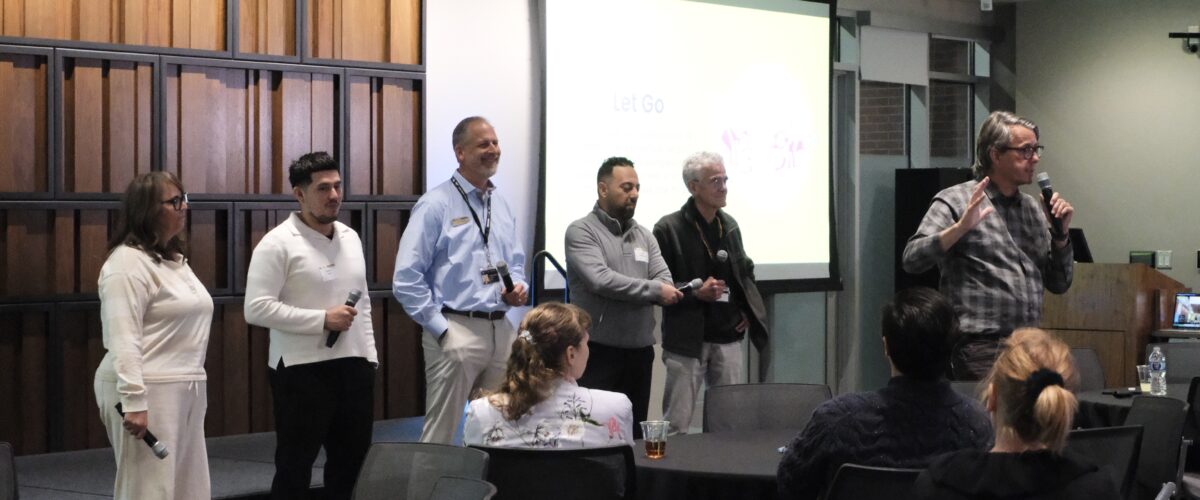

CU Denver Business School’s Alumni Network welcomed Brad Robertson of On Your Feet for an interactive evening exploring how improvisation can help professionals navigate uncertainty, communicate with intention, and approach everyday challenges with a different mindset.
What happens when five strangers are asked to create a story together, but each person can contribute only one word at a time?
At CU Denver Business School’s The Improv Mindset: Master The Art of Thinking on Your Feet event, the result was an unpredictable and creative story that had the audience laughing. With no script to follow and no way of knowing what the next person would say, the volunteers had to listen, adapt, and build on each other’s contributions.
It was a lighthearted exercise, but it introduced an important lesson: improvisation is something we practice every day, often without realizing it.
The Business School Alumni Network (BSAN) welcomed alumni, students, faculty, staff, and members of the business community to the Jake Jabs Event Center for an interactive evening with Brad Robertson, a partner at On Your Feet.
Through storytelling, partner exercises, and discussions, Robertson challenged attendees to reconsider how they communicate, collaborate, and respond to the unexpected.
Improv Isn’t Just for the Stage
Robertson brings a combination of business, education, and improvisation experience to his work. As a partner at On Your Feet, he has worked with organizations such as Apple, Nike, Disney, Intel, Starbucks, Netflix, and FedEx. He holds a bachelor’s degree from the University of Oregon and an MBA from Portland State University.
He began the evening by asking attendees a simple question: What is improv?
For many, the word brings to mind comedy, theater, or performers creating scenes without a script. But Robertson encouraged the audience to think beyond entertainment.
“We don’t know what is going to happen next. We don’t know what our teammates are going to do, and at some deep levels, it seems to me I don’t even know what I am going to do,” Robertson explained.
He suggested that lessons from the improv stage can help people navigate uncertainty, even if they never perform on stage themselves.
Consider an everyday conversation. No matter how carefully someone prepares, they cannot predict exactly what another person will say. A meeting may take an unexpected turn, a project may require last-minute adjustments, or a plan may change entirely.
In each situation, people are already improvising.
Robertson’s goal wasn’t to turn attendees into performers. Instead, he wanted to show how improvisation can help people become more adaptable, attentive, and intentional in their professional and personal lives.
Learning to Collaborate Without a Script
Throughout the evening, Robertson invited attendees to practice improvisation through a series of interactive exercises.
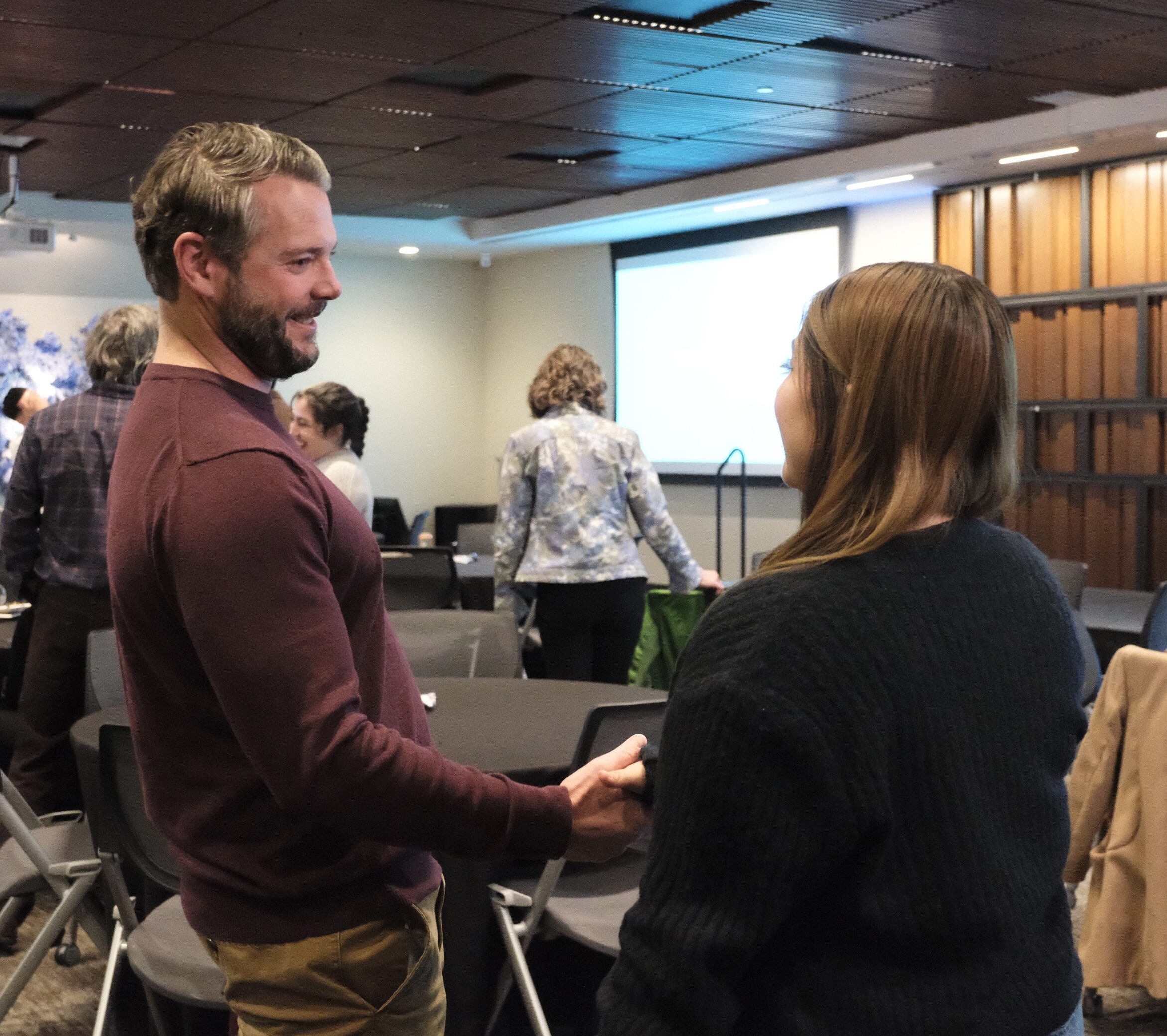
In one activity, a participant invented a story about an imaginary character, then switched roles with their partner, who continued the narrative. Another activity asked partners to imagine giving each other a gift, prompting them to express thanks or displeasure.
While the activities encouraged creativity and humor, they also showed how easily communication can break down when people focus too heavily on their own ideas.
Successful collaboration requires more than having something to contribute. It also means listening carefully, recognizing what others bring to the conversation, and being willing to adjust.
Moments like these reflected the spirit of the event, where unexpected responses became opportunities for connection rather than interruptions.
Three Principles for Navigating the Unexpected
Beyond the exercises, Robertson introduced three principles that form the foundation of an improv mindset: Let Go, Notice More, and Use Everything.
Let Go encourages people to release their attachment to outcomes they cannot control, including fears, expectations, and the need to plan every detail.
On stage, performers cannot determine what their partners will say next. Similarly, professionals cannot always predict how colleagues, clients, or circumstances will respond to their plans.
Learning to let go creates room for flexibility and new possibilities.
Notice More emphasizes the importance of paying attention to others and the surrounding environment.
During the storytelling exercises, participants had to listen closely to continue the narrative. Missing even a single contribution could change the story’s direction.
In professional settings, the same principle applies to conversations, meetings, and collaborative projects. Listening carefully and recognizing what others need can be just as important as communicating one’s own ideas.
Use Everything encourages people to work with the information, ideas, and opportunities available in the moment rather than dismissing unexpected contributions.
An unfamiliar suggestion or unplanned development doesn’t have to become an obstacle. It may offer a new direction worth exploring.
Together, these principles encourage a mindset that values adaptability, awareness, and collaboration over rigid expectations.
How Our Mantras Shape Conversations
Robertson also explored how the language people use can influence the direction and outcome of a conversation.
“A mantra is a belief you carry in your mind as you go about your day. It can take the form of a simple phrase, but what’s interesting is that you can often see it reflected in someone’s posture,” Robertson explained.
Robertson reinforced this lesson through a staged workplace video showing versions of a conversation between colleagues, showing how small changes in communication can influence whether someone feels supported and whether a conversation moves forward.
The lesson wasn’t simply about being positive. It was about clarifying intentions, responding thoughtfully, and recognizing opportunities to help others feel heard.
In business environments, where communication shapes relationships, teamwork, and decision-making, these choices can make a meaningful difference.
The Value of Thinking on Your Feet
By the end of the evening, the audience had experienced improvisation not as a performance to watch, but as a skill to practice.
From creating stories one word at a time to navigating imaginary scenarios with a partner, each activity reinforced the importance of listening, responding, and remaining open to unexpected possibilities.
For the Business School community, The Improv Mindset: The Art of Thinking on Your Feet offered an opportunity to explore professional development in a setting that encouraged experimentation, creativity, and connection.
Robertson’s message offered a practical way to approach those moments: let go of what cannot be controlled, notice more of what is happening around you, and use what is available to move forward.
After all, improvisation isn’t limited to what happens on stage. It’s part of work and life, today and tomorrow.
Interested in supporting future BSAN events? Learn how you can get involved and contribute to meaningful experiences for the CU Denver Business School community here.
