
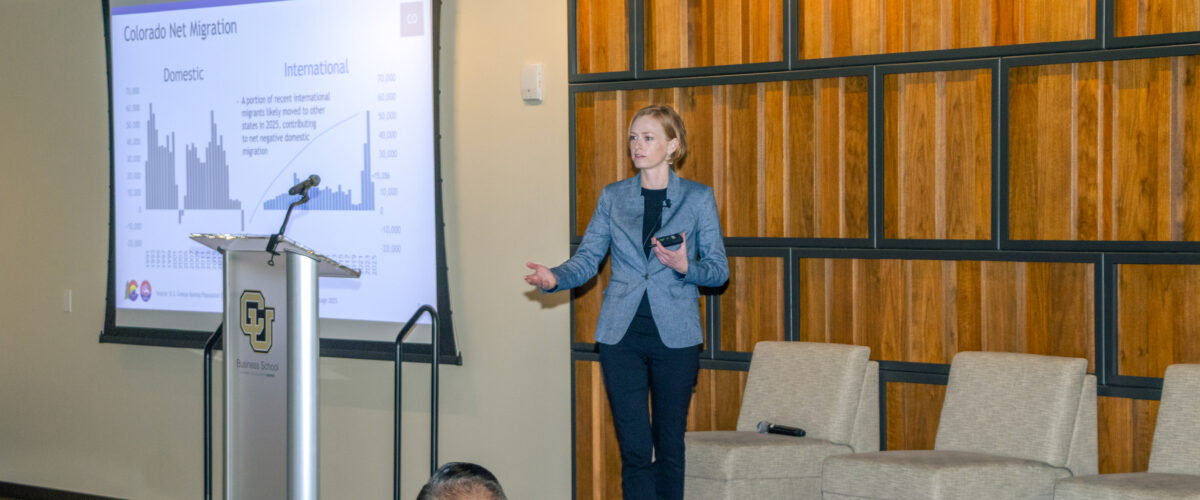

From the Iran war to rising energy prices, the American economy appears as split as ever. At the annual 2026 Economic Forecast event, featuring Ellen Zentner ’95, Morgan Stanley’s Chief Economic Strategist, and Kate Watkins, Colorado State Demographer, one underlying tension quietly sat beneath nearly every discussion point: who is paying for that split, and who is profiting from it? The conversation moved rapidly between global instability, labor participation, slowing population growth, immigration, housing affordability, and market performance. Rather than offering simple answers, many of the insights presented during the discussion seemed to spark a broader question about how Americans are experiencing the economy in entirely different ways despite existing under the same system.
One remark during the discussion particularly stood out. Similar to a “Miyagi Way” of economics, the best remedy for high energy prices may simply be high energy prices themselves. As prices rise, behavior adjusts. Consumption changes. Markets eventually stabilize under pressure.
That idea raises an interesting question: who can actually wait for markets to stabilize?
For some Americans, rising oil prices may mean adjusting investments, delaying purchases, or shifting financial strategy. For others, it immediately affects transportation, groceries, rent, and everyday comfort. The same economic event creates entirely different realities depending on someone’s relationship to money, assets, and financial flexibility.
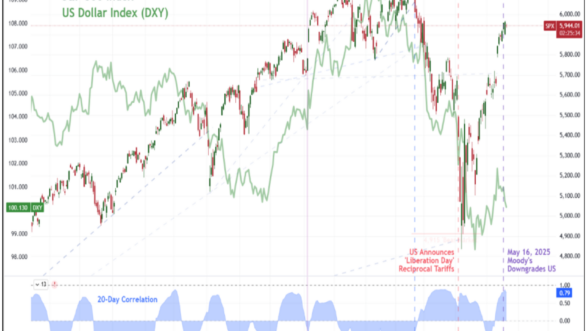
Another insight that sparked a larger question surrounded market performance and public perception of the economy itself. Despite popular assumptions, there appears to be little meaningful long-term correlation between the amount of money printed and the movement of the S&P 500. Investor enthusiasm, interest rates, and global confidence appear to influence market performance far more aggressively.
https://www.stonex.com/en/insights/06-03-2025-market-tools-correlation-sp-500-dollar-over-time
When paired with broader international market performance, this raises an even larger question surrounding what modern markets are actually reacting to. Historically, global markets have generally risen, regardless of whether the dollar strengthened or weakened. That observation suggests that modern economies may be driven just as much by confidence, momentum, and belief in future ownership as they are by present-day material conditions.
In many ways, perception itself may now function as part of economic infrastructure.
During the Economic Forecast event, the Colorado demographic outlook segment introduced another layer to this broader conversation. Watkins shared that population growth is slowing. More people are aging out of the workforce while birth rates continue to shrink. Immigration patterns, historically one of America’s strongest forms of labor replenishment, have also shifted dramatically in recent years.
Even employment statistics themselves appear increasingly nuanced (for example, 38% of the American workforce, representing an estimated 64 million professionals, has actively engaged in some form of freelance or gig work as part of their income mix). Higher unemployment may partially reflect a growing number of skilled workers actively seeking better opportunities rather than an immediate economic collapse. At the same time, more Americans are pursuing self-employment, independent contracting, or alternative income streams outside traditional corporate structures.
Taken together, these insights begin to raise a broader question about how Americans interact with the economy itself.
Through laws governing private business and ownership, class-shaped social norms, and varying education, America increasingly appears to operate through two overlapping systems: the spending economy and the ownership economy.
The spending economy is where most Americans physically experience daily life through wages, groceries, transportation, debt, tuition, rent, and consumption. The ownership economy functions through appreciating assets, business equity, stocks, real estate, and long-term capital growth.
Both economies rely on one another. Yet they often produce entirely different experiences of opportunity and financial pressure. It’s the daily, cumulative choices that can change your life one way or the other, because every decision involves the dollar in the U.S.
